
Categorías: Destacada, ECCTA Papers, Noticias de Interés
Por Espacio ECCTA
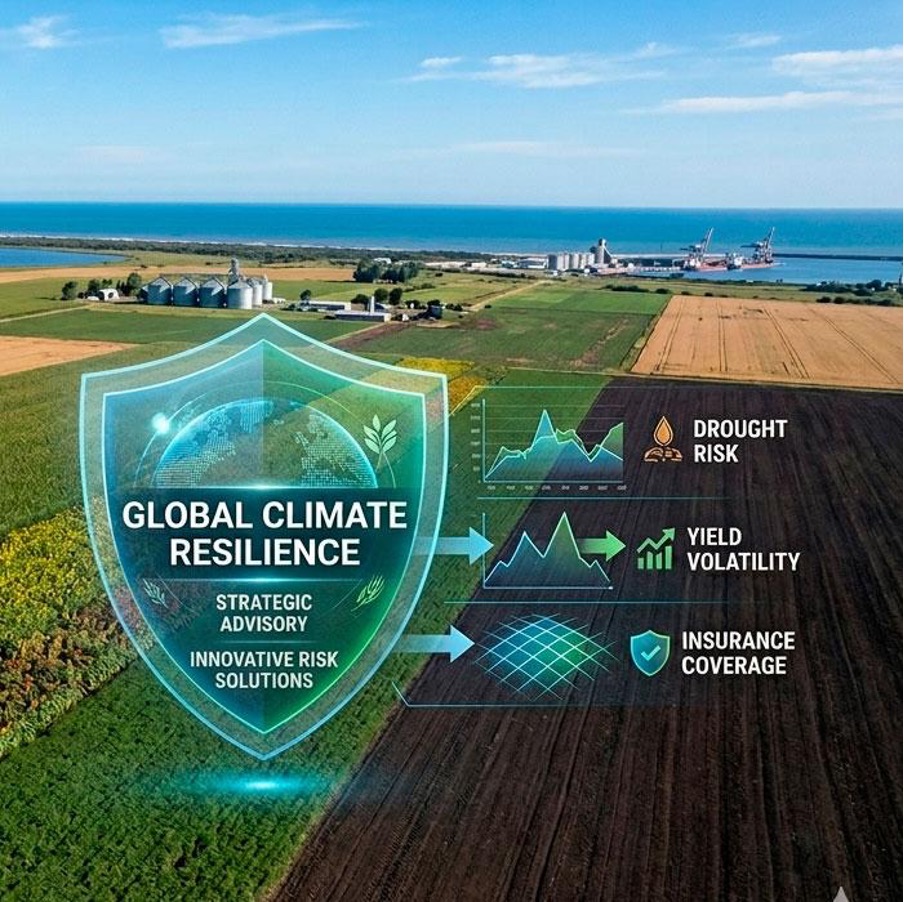
The following analysis on global market shifts, agricultural resilience, and environmental regeneration is highly inspired by the strategic insights published by @[Gallagher] in their recent publication, The Impact of Climate Insurance Risk on Your Business. Their framework on navigating evolving climate volatility underscores the urgency of the institutional challenges addressed below.
The great fertile plains, which produce food for the majority of the world’s population, must be cared for as much as the oceans. The world as a whole should pay careful attention to these exceptional «green oceans.» Insurance and Reinsurance are mandatory participants for adequate preservation.
Throughout history, nature has shown us its majesty on repeated occasions. It almost always responds to a random sequence of events caused by the planet’s dynamics during its evolution. Frequently, this continuous and internal revolution discharges a devastating portion of its products onto the surface, which forces us to suffer the destructive consequences they cause.
However, they do not always generate only damage and losses. Tens of thousands of years ago, some global eruptions threw out millions of tons of Loess, a sedimentary geological material very rich in microelements. Dominant winds continued the work, distributing this material over the surface, although subsequent adequate conditions only allowed a few zones on the planet to manifest this potential:
- The Mississippi basin in the USA, with more than 3 million square kilometers.
- The war-battered “Black Sea Plain,” extending between Russia and Ukraine.
- The Huangpu plateau in China, known as the Loess Plateau, at 1,200 meters high and 640 thousand square kilometers, slightly larger than the surface area of France.
- The Humid Pampa, with almost 40 million hectares which, thanks to the winds and rains, over time consolidated a territory with rich, deep soil, whose productive wealth seems inexhaustible, although it is not. 🇦🇷
In fact, the Loess Plateau is probably the largest environmental regeneration project in the world. This high plateau, surrounded by the Yellow River, in the cultural and historical heart of China, is a great example of ecological restoration. A few centuries ago, this great expanse generated wealth through agricultural and livestock exploitation. However, excessive land use caused the destruction of the ecosystem, turning it into almost a desert. Repeated floods and soil erosion transformed this plateau into one of the poorest areas in China.
In the 90s, the Eastern nation implemented some programs to reverse this process, such as artificial slopes to improve water infiltration, the planting of species adapted to the local climate, controlled goat grazing, and the construction of small dams, among others. In just one decade, the results were astonishing, both for the pace of vegetation growth, the halt of erosion, and the sequestration of more carbon from the atmosphere. Two and a half million people were lifted out of poverty, the employment rate increased, and food security was achieved for a significant part of its inhabitants.
The net benefit was positive for the ecosystem. To such an extent that the model expanded to other countries in the region such as Jordan and Ethiopia, where desertification was advancing, endangering food production.
Although many think there is an open discussion between wildlife or crops, I do not find sufficient reasons for this dilemma to exist. The main objective must be the protection of these privileged areas and for the participation of insurance and reinsurance to be relevant in that task.
In our country, the limit for dryland agriculture is the 600 mm annual isohyet. The Humid Pampa extends from that line eastward to the sea, where the availability of rainfall increases in the same direction, allowing the development of extensive crops without artificial irrigation, such as wheat, corn, soy, and sunflower, among the most important, plus more than 50 million head of cattle. Over the last 60 years, the combination of climate, the development of genetic materials, and the management of agricultural plots have increased both yields and their volatility. Likewise, it is not difficult to verify that two-thirds of the losses due to climatic reasons correspond to drought.
In that same period, the asymmetric distribution of land improved, which was subdivided by inheritance, partial sales, or expropriations. This atomization generated a large group of medium-sized farmers, rich in assets but poor in cash flow.
At RiskGroup Argentina, we observe that, at the same time, given the need caused by the search for efficiency, they became professionalized to the point of embracing technology, sharing experiences and resources, in addition to being willing to transfer some of the risks inherent to the activity.
Conversely, the absence of subsidies, credits, insurance, and guarantees, added to increasing fiscal pressure and an unstable exchange rate, leads to the available financing coming from the rest of the members of the agro-food chain. These «Aggregators» (exporters, input suppliers, banks, governments) are responsible for the provision of inputs, the commercialization of the final product, offering credit, and even collecting taxes, to name a few examples. They share the same fate as the agricultural producer, although when faced with the possibility of transferring catastrophic risks, they behave erratically, just like many of their farmer «partners,» closer to assuming the risk than transferring it.
This «backdrop» represents a great challenge for the insurance industry, given that the current situation requires taking the necessary actions to ensure that luck plays in their favor, they limit their risks, and they do not decapitalize.
Paraphrasing Borges, it doesn’t matter where we arrive, only where we are going.
#RiskManagement #RiskGroupArgentina #Reinsurance #ClimateRisk #Agribusiness #Sustainability #ThoughtLeadership
Compartir

11 abril, 2024
Por Espacio ECCTA
¿Qué hacer y cómo protegerse?

28 marzo, 2024
Por Roberto Pradier
Argentina sufre una altísima inflación y las perspectivas no son prometedoras.

21 marzo, 2024
Por Marcelo Rodriguez
El lugar que ocupa el reaseguro en el gran negocio del seguro es considerable.

23 febrero, 2024
Por Ricardo Pantano
El Seguro y el Reaseguro son partícipes obligados para una adecuada preservación.